
Part 2: Your First Session: A Step-By-Step Walkthrough
Welcome back. Last time we talked about what an ST does. Now it's time to do it.
We're going to walk through one specific adventure, Dangerous Art: A Colorful Adventure (written for D&D 5th edition and compatible with the 2024 rules), and I'm going to show you what running it actually looks like. What to say out loud. How to handle exploration. What to do when the dice hit the table.
Before You Sit Down
You've picked your adventure and read it through at least once. Now let's talk about what you were actually reading. Most one-shots follow a familiar narrative arc:
Opening: The players learn where they are and what's happening.
Players do stuff: They explore, gather information via NPCs or investigation, and progress the plot.
Action: Things begin moving toward the final act. The players might find the dungeon entrance and start exploring, or they might get pulled into a battle. Whatever form it takes, this is the crescendo before the conclusion.
Resolution: Everything gets nicely wrapped up. The players achieve their goal and get rewarded for their efforts. Maybe there’s a parade, but most want gold.
In Dangerous Art, that arc looks like this: the players encounter the grieving husband looking for their wife at the tavern. They investigate the town, discover that her paintings are magical, get transported inside one, fight painted goblins, rescue the artist, and escape. A linear story structure with clear stakes and plenty of room for your players to surprise you.
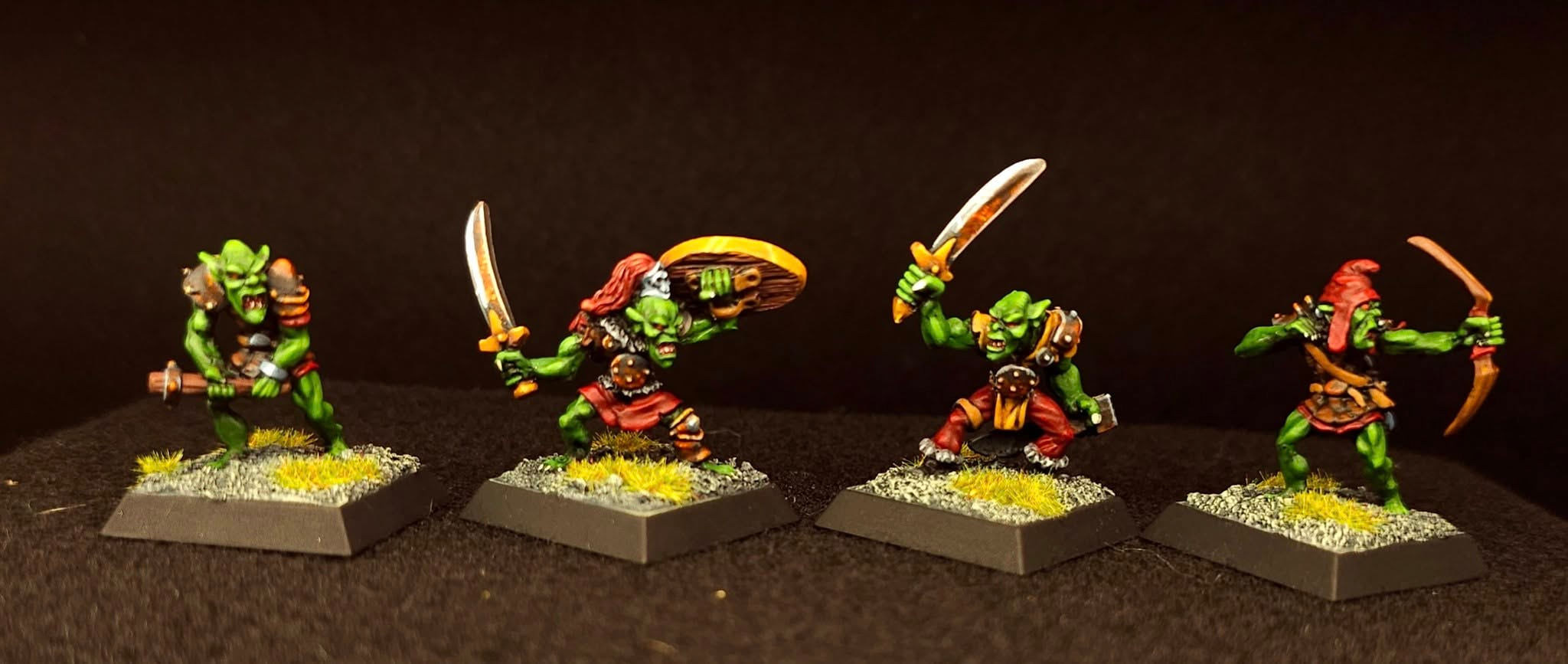
Inside the painting, even the goblins are made of pigment. And they bite back. Credit: Julian Rodriguez and Reaper Miniatures.
Opening the Session
Your players are at the table. Snacks are out. Everyone's looking at you. Now what?
Most adventures include read-aloud text: pre-written descriptions you share verbatim with your players to set the scene. In Dangerous Art, the opening goes like this:
"The summer petals have curled brown to mother earth, hidden beneath garlands of oranges, reds, and golds. Autumn's arrival brings a time of harvest, of evenings with warm drinks and warmer friends..."
Take your time with it and let the words land. After the opening, give each player a chance to introduce their character, premade or otherwise. I like to go around the table one at a time. The adventure provides simple prompts to get players talking in character: what they look like, what attitude they give off, and what they ordered.
These are small questions, but they get players talking in character right away.
-
This happens more than you'd think, especially if your players are new or feeling shy. Don't force it. Instead, flip the script: you describe what the table sees. "The door to the tavern opens and in walks a tall figure in a weathered cloak, hand resting on the hilt of a sword. They look like they haven't slept in days." Then turn to that player and ask, "Does that sound about right, or would you change anything?" It takes the pressure off performing and lets them ease in. Dorella the waitress is also your secret weapon here. Have her walk up, slide a drink across the table, and ask, "So, what brings you lot to Otter Ferry?" Now the players are responding to a character, not presenting to an audience. That's a much lower bar.
Then the story kicks in. A disheveled man in carpenter's clothing, Devalyn, bursts into the tavern and starts whispering to the bartender. Here's where you get to make your first ST decisions. The adventure gives you two ways for players to learn what's happening: characters proficient in Perception, the skill that covers listening and spotting details, might overhear the conversation, or the waitress Dorella can fill them in.
Having several methods of getting the same information comes up a lot in adventure design. It means no single failed dice roll can stall the story.
Chatting with Devalyn
Your players will almost certainly want to talk to Devalyn.
The adventure includes a list of things he'll share and things he'll withhold unless persuaded via the Persuasion or Intimidation skills. You don't need to memorize it all. Glance at the bullet points, get a feel for who this guy is (worried, protective, desperate), and respond as him.
If a player asks something you didn't prepare for, improvise. Maybe Devalyn nervously avoids the question. Maybe he changes the subject. There's no wrong answer as long as the story keeps moving. I wrote about why being willing to suck is actually an ST superpower if you want a pep talk before sitting down.

Exploration and Breadcrumbing
Once Devalyn leaves or the players finish talking to him, they have the run of Otter Ferry. The adventure details several locations: the tavern, a general store, a hunting lodge, and the Veralas residence. Just because only four locations are listed doesn't mean the town has only four buildings. If a player asks, "Is there a blacksmith?" you can say yes and make one up on the spot.
Each provided location offers an opportunity to advance the narrative; that’s why they’re fleshed out and mentioned. This is a concept called breadcrumbing, and it’s the art of leaving a trail of clues that guide players toward the next story beat. Each clue earns the next: the bartender points to the husband, the husband points to the house, the house leads to the studio, and the studio leads to the painting. The Story Secrets & Clues on the adventure's second page are built for exactly this.
The Residence
The Veralas residence is where things get interesting. The adventure breaks down the house room by room: dining area, kitchen, bedroom, workshop, and studio. Each room has a short description, and maybe some loot, but the key location is the studio. That's where the magical painting lives.
If your players don't head to the studio on their own, this is where your NPCs do the work. Maybe Devalyn nervously suggests they check his wife's workspace. Maybe he begins to trust the players and reveals that her paintings have a secret. There are many ways to nudge the story forward without dragging your players by the hand.
-
A second bedroom converted into a painter's studio. Bottles of pigments line a worktable. Beautiful landscape paintings hang on every wall. And in the center of the room, resting under a canvas, is one more painting. This one is... moving."
Then: "What do you do?"
-
They will, because you're going to describe it. The painting is the centerpiece of the studio, and when you read that room description aloud, you're literally telling them there's a painting that's moving. That's not subtle. But let's say they get distracted by the loot on the worktable or start investigating the window. That's fine. Let them explore. Every clue in the studio points back to the painting: the missing paints, the scuff marks, the magical residue. If they're really not biting, Devalyn can say something like, "Her latest piece... it was different from the others. She wouldn't let me see it." Or the painting itself could react, maybe the colors shift, or they hear faint sounds coming from the canvas. In essence, you're making the most interesting thing in the room hard to ignore.
Inside the Painting
The players find themselves in a strange, painted forest. Colors are too bright. The ground sloshes like wet paint. The horizon looks blurry. This is a great moment to lean into description. The adventure even gives you sensory details: the smell of turpentine, the unnatural pigmented light. Share those. They make the world feel alive (even when it's literally made of paint).
Ratesi, the missing painter, is waiting nearby and explains the events leading to her present situation. Now the party needs to recover those magical paints to escape and complete the adventure.
Traps on the Path
The painted path leads through an overgrown section with traps that the goblins have set. You describe the scene verbally, ask your players what they do, and let their choices drive what happens. If someone says, "I check for traps," you call for a roll. If they just march forward without looking, the traps spring.
If a player falls into a pit trap? They take a little damage, and their clothes are stained with paint. It's dangerous and silly. That's the tone of this adventure.
-
Theater of the mind means describing everything verbally. Players picture it in their heads. No map, no grid, no miniatures. This works great for exploration, traps, and smaller encounters.
The Goblin Encounter
The path ends at a clearing where six painted goblins and their boss, Acrylic, are camped around a painted throne. This is the adventure's only combat encounter, and it's okay to feel nervous about it.
When combat starts, everyone rolls initiative: each player rolls a d20 and adds their modifier, and you do the same for the goblins. The highest goes first. Then you go in order. On a goblin's turn, you decide what it does (attack, hide, run). On a player's turn, they tell you what they do. Attacks are resolved with dice rolls against Armor Class (AC). If the roll plus modifier meets or beats the target's AC, it hits. Roll damage. That's the cycle. If it feels like a lot, I wrote about why you don't need to know every rule to run a great fight.
You don't need a grid or miniatures for this. Theater of the mind works fine: describe the clearing, the throne, the goblins cackling over their piles of poorly painted gold.
-
A stat block is the stat sheet for a monster or NPC. It lists their health, armor, attacks, and special abilities. In Dangerous Art, the stat blocks for the painted goblins and Acrylic are in the appendix. Keep them in front of you during the fight.
-
"Acrylic spots you from his throne and shrieks something in Goblin. The goblins scramble for their weapons. Roll initiative!"
[Everyone rolls]
"Okay, Sarah, you're up first. There are three goblins between you and the throne, and two more flanking from the right. What do you do?"
Sarah: "I cast Sacred Flame on the closest goblin!"
"Nice. The goblin needs to make a Dexterity saving throw... and it fails. Roll your damage."
-
Both of these are more common than you'd expect, and both are fixable on the fly. If the fight is too easy, the adventure already has your back: defeated goblins can merge into a gray paint ooze. You can also have Acrylic call for reinforcements, or have the goblins fight smarter by using cover, flanking, or targeting the spellcasters. If the fight is too hard, you have options too. Goblins are cowardly by nature. Once two or three go down, the rest might flee or surrender. The goal isn't a perfectly balanced encounter. Adjust as you go and nobody will ever know.
Ending the Session
Once the players reclaim Ratesi's paints and brushes, she can paint a portal to escape. The heroes get their rewards: a magical brush, 40 gold, and a likeness of themselves painted into the work they just escaped from.
You can end the session the moment they reclaim the paints, or you can play out the escape and the return to Otter Ferry. Either way, once the story wraps, take five minutes to jot down what happened. Who did your players talk to? What choices did they make? What surprised you?
A Note for Parents
If your kid is the one behind the screen, the best thing you can do is be an enthusiastic player, not a co-pilot. Let them stumble over rules and forget NPC names. Resist the urge to correct them mid-session; momentum matters more than precision. Lean in, ask questions in character, and when it's over, tell them what you liked. That feedback goes further than you'd think.
Your Turn
You've seen what a session looks like from start to finish. The read-aloud, the exploration, the improvisation, the dice. It's not as mysterious as it seems from the outside.
In the final article of this series, we'll talk about what happens after your first session. How to build confidence, find your style, and keep the momentum going.
Until then, go rescue a painter.
Chris Vicari is an educator, professional Dungeon Master, and the author of the upcoming Behind the Screen: A Dungeon Master's Guide to Crafting Campaigns (2026). He writes about DMing, confidence, and the craft of running great games on his Substack. You can find him at https://behindthescreendnd.substack.com/.
