
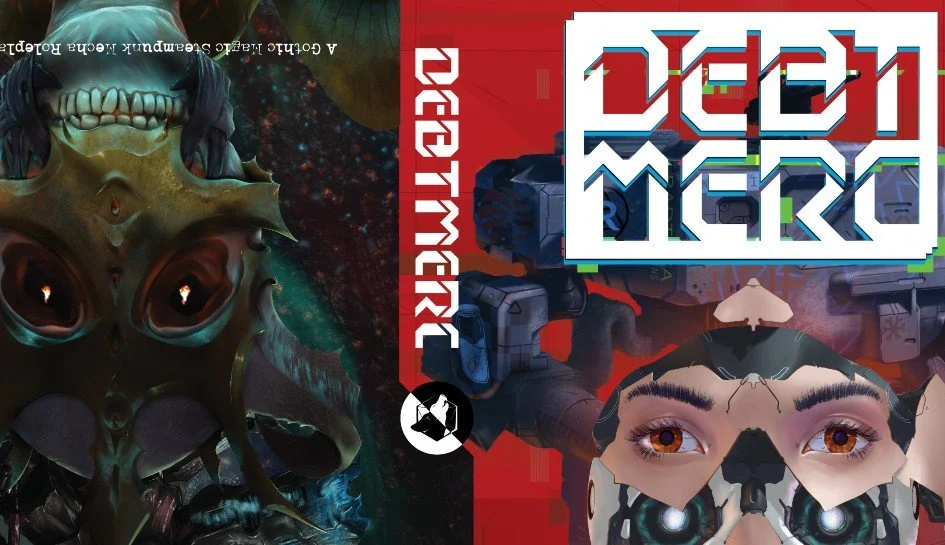
DEBT MERC & Emberjack Offer Two Ways To Die Glorious Deaths
Whether a particular Storyteller out there is looking for the setting for their next epic Cyberpunk campaign or dark fantasy chronicle, or just a simple and approachable mecha combat system to bolt onto another game’s system, the DEBT MERC and Emberjack double campaign book has plenty to offer. I also recommend STs look to the idea of running short, tragic stories in both settings. Even if the intent is to run a grand campaign that sees the capitalist system of DEBT MERC torn down once and for all, a short adventure that humanizes all the mercs who don’t survive to see their debt paid down can add context and emotional investment to the world.

As An Appetizer To The Rich, You Can Eat the H.I.V.E.
Eat the Reich uses very simple mechanics, a straightforward dice pool system where the players roll against the Storyteller to determine if they succeed at their actions, most of which are the violent murders of Nazis. It is largely Narrativist, encouraging players to get creative with their carnage, with little opportunity for Gamist builds or strategies. Eat the H.I.V.E. takes all of these elements and repurposes them into a far future setting which includes many fantasy elements like dwarves, orcs, and elves. Capitalist overlords hoard the wealth and profit from the labor of the poor, which is just the status quo of the world we live in, set in space.

Magical Anarchy & Other RPG Campaign Adaptations Can Thrive
Adaptations of Tabletop RPGs to other mediums include the video game Disco Elysium, The Expanse novel series, and many more. Magical Anarchy is an upcoming audio drama adaptation of The Seventh Age, a fantasy novel series adapted from a World of Darkness LARP Chronicle. These adaptations are wonderful for the TTRPG hobby, and for storytelling as a whole.

Severed Threads Shows Anyone Can “Direct” The Black Ballad
The Storyteller running an adventure is the Director. They can coach their players on the tone they are seeking with any campaign, whether it’s a grim and sorrowful Mike Flanagan-Directed Black Ballad, or a whimsical low-stakes Tim Burton take on the same source material. Life can be hard enough as it is, and sometimes a group might worry that a particularly serious and immersive game, ran in the classic World of Darkness style, might add to their stress level rather than taking away from it. That doesn’t mean that the starker adventures like The Red Opera or The Black Ballad need to be off the table for them, simply that the Storyteller might choose to direct them with a more lighthearted flare.

Candlelight Inquistion
Candlelight Inquisition is a “Gothic Noir” indie tabletop roleplaying game designed for a game master and 1 to 4 players. Engage in investigation, social-political intrigue, and wrestle with your character’s internal psyche as they face opposition and uncertainty.

One Piece Is A Masterclass On D&D Adventuring Days
If you set aside a weekend or six to watch either the Dressrosa or Wano Arcs of One Piece, you’ll see that those arduous adventuring days include a lot of defining elements of heroic fantasy Tabletop RPGs, not just a series of back-to-back combats. In both arcs characters infiltrate enemy encampments using disguises (usually comically terrible ones, but sometimes people roll poorly and still get by). There are alliances made with local resistance fighters. Add a few traps for the Rogue and you’re not far off from an iconic D&D adventure. Just avoid splitting the party as much as Shonen Anime tends to, for your own sake.

Why Crunchy RPGs Offer Two Games In One
Storytellers need to remind themselves that player agency matters in all facets of the game, not just at the table. They should also be eager to court any source of player “buy in” and enthusiasm, which certainly should encompass the campaign’s theme and narrative, but it can also include game mechanics. If a player organically chooses to change their planned build, and instead focuses on the use of an overpowered magic item the Storyteller gives them, that isn’t agency, that’s the Storyteller dictating a character’s build for them, in essence. So long as reasonable guardrails are in place, the character-building game adds value to TTRPGs.

Who’s Afraid Of The Big Bad Metaplot?
Metaplot in tabletop RPGs has proven to be among the most strangely divisive features any game line can offer. For a brief definition, in the context of RPGs Metaplot generally refers to a set of canon events that slowly reshape a fictional setting over time. Traditionally Metaplot was offered through a slow drip feed of information in supplemental books, though it was sometimes also updated in large chunks in new editions of core books. While Metaplot bore a poor reputation as of the mid 2000s, I think we need to reassess its role in the hobby. Honestly, I miss it.

Part 3: What Happens Next: Building Confidence and Finding Your Style
Build Confidence as a GM or Storyteller. How to make the game yours and not fall to the Mercer effect.

Part 2: Your First Session: A Step-By-Step Walkthrough
A Step-by-Step Walk Thru on Planning your TTRPG sessions part 2! The Guide for GM’s and ST’s!

Part 1: So You Want to Run a Game (Yes, You Can Do This)
Guest Writer Chris Vicari deep dives into the process of becoming a Storyteller for your TTRPG projects. Start Here!

Worldbuilding. Let’s set the stage.
Worldbuilding. Arguably the hardest part of any form of writing, not just in table-top role-playing games. Your world is the setting of your entire campaign, and if there’s one guarantee throughout entertainment, your viewers/ players will do everything in their power to poke a hole in your hard work.
Trust me, I know. I’ve only gained my skills in worldbuilding by having one particular member of my table incessantly pick apart the details.

Go Long! Plotting Your First Long Form Adventure
We’ll start this first article with the basics of plotting an adventure. Now, there are two ways to go about writing in general, not just for TTRPGs, outlining and pantsing. This is a blog about writing for TTRPG, but the foundations are fundamentally fantasy and sci-fi writing, and I recommend the lecture series by Brandon Sanderson I watched when I first learned how to write fantasy (Or at least, a more recent version of it.)
We have our heading! Let’s make a one-shot map.
A one-shot is a small adventure designed to be played in a single sitting. Depending on your group, the size, and the length of your sessions, that could change the dynamics of what you’ll be able to do. A four-person 4 hour session will be able to get through a slightly more complex story than a six-person 3 hour session. You will also want to tailor your one-shot to the playstyle preferences of your party. One of my parties are fans of action, so the one-shots I write for them tend to be heavy on combat. Another one-shot I ran for a group of young teenagers was simplified in scope and complexity to be more accessible to their age group. These minor adjustments will make all the difference in a smooth game day.

The ST Forge - Talking Tolkien with Don Marshall
Pat is joined by Don Marshall, the "Obscure Lord of the Rings Facts Guy" himself, to discuss his new book: JRR Tolkien the Father of Modern Fantasy.
Let’s Craft a One-Shot: The Short Stories of TTRPGs.
A one-shot is a small adventure designed to be played in a single sitting. Depending on your group, the size, and the length of your sessions, that could change the dynamics of what you’ll be able to do. A four-person 4 hour session will be able to get through a slightly more complex story than a six-person 3 hour session. You will also want to tailor your one-shot to the playstyle preferences of your party. One of my parties are fans of action, so the one-shots I write for them tend to be heavy on combat. Another one-shot I ran for a group of young teenagers was simplified in scope and complexity to be more accessible to their age group. These minor adjustments will make all the difference in a smooth game day.

The ST Forge - Episode 13 - Cosmic Century Knights
In our 13th episode, James D’Amato returns to showcase Cosmic Century Knights

Epic Quests are Dangerous: Equip yourself to run your First Campaign with these Tips!
In this article, we go over ‘TTRPG Overhead.’ These are the broad real-world considerations to take to follow that will help you run a successful campaign with stories told around a campfire for decades to come.
The ST Forge - Episode 12 - Dungeon Tryouts
In our 12th episode, Pat talks with Peter Chiykowski and Miroki Tong from The Story Engine