
Candlelight Inquistion
A written interview conducted by John Murry
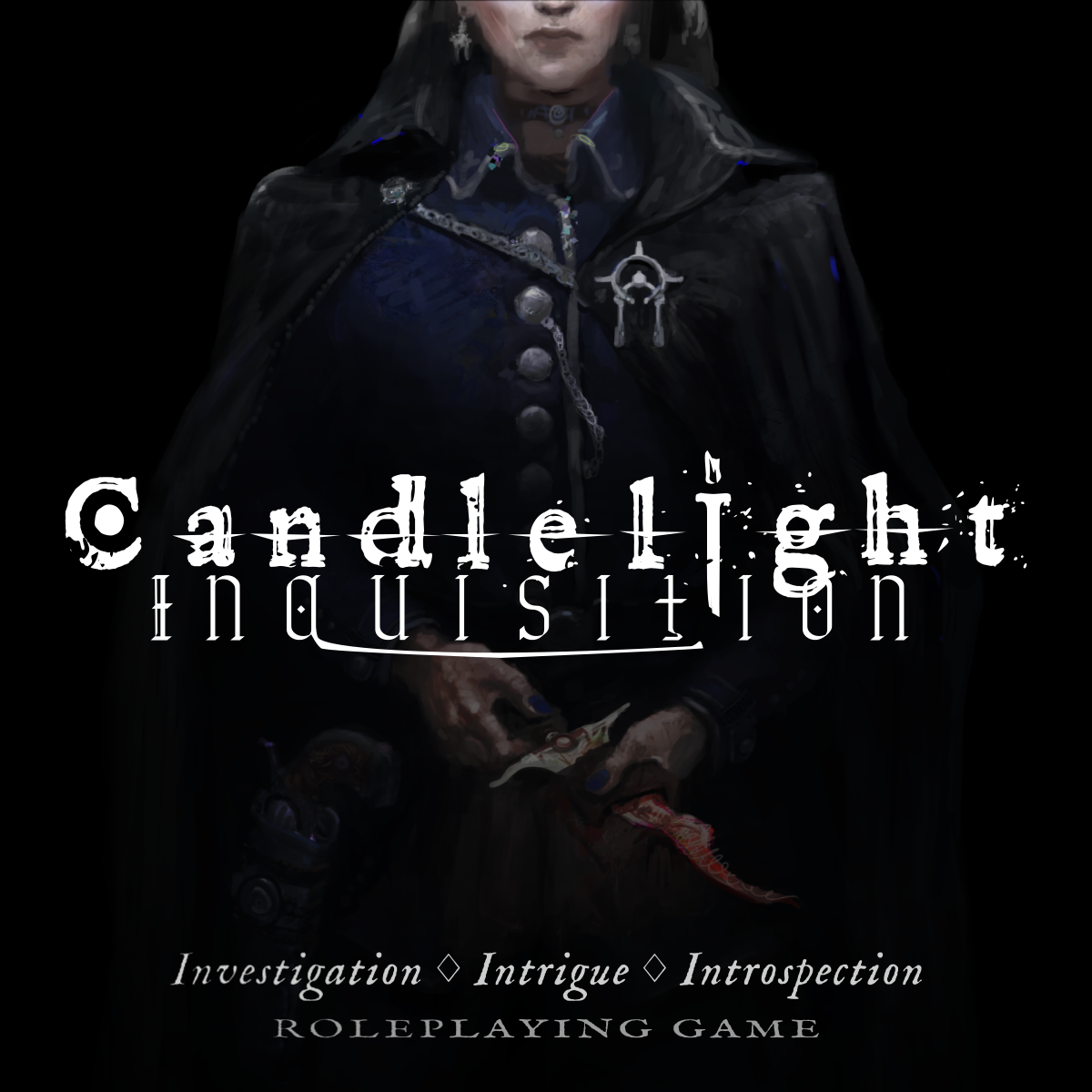
Candlelight Inquisition is a “Gothic Noir” indie tabletop roleplaying game designed for a game master and 1 to 4 players. Engage in investigation, social-political intrigue, and wrestle with your character’s internal psyche as they face opposition and uncertainty.
I had a chance to sit down with Will Fish of Black Mouth Cur Gamecraft and speak to them about their upcoming and recently crowfunded release of Candlelight Inquisition, a system which i was immediately drawn too and backed myself and I hope after hearing about it you will feel the same.
1. What type of system does this use, is it a known system like d20 or something designed in house?
Candlelight Inquisition uses a custom 2d6 system. It has influences from multiple systems including Powered by the Apocalypse, Gumshoe, and Fate, and is most similar to Forged in the Dark. The intent was to create a “fiction-first” system where the narrative and roleplay was supported, not detracted, by having many explicit ways to use your character features, to create a system which embodied themes of mental perseverance and attrition, and to create a system which facilitated investigations.
2. What first sparked the idea for Candlelight Inquisition?
Most directly? A boyish desire to create my own cool RPG after playing some other ones. Candlelight Inquisition arose from a project I started when I was 12. It grew with me: taking on new influences as I had new experiences, becoming refined as my design skill increased, becoming more honed in its purpose as my own ideology matured. The game and setting is very different now, to say the least. A deeper answer to this question — the idea that kept this project alive all this time — is that I wished to have a game which reflected my feelings about the search for what is good and right: that it is impossibly vague, that the world and even our own preinclinations are set against it, but that the search is not fruitless; goodness can be found even in the most grey-dark haze.
3. What drew you to combine gothic horror, noir, and investigative gameplay into one setting?
I think the idealism present in classic gothic media (if you doubt me, just read the original Dracula) has an interesting contrast with the cynicism of noir. Gothic horror tropes like the supernatural help bring high concept themes to the forefront. It’s hard to see any high spiritual or emotional truth when tangled in sociopolitical conflict, but much easier when face to face with the gods of the Dream, or the depraved bio-tech horrors of Antiquity. On the other hand, noir might show the world in all its ugliness and demonstrate how blurry the line is between good and evil. To me this exposes not the weakness of ideals, but their necessity. In Candlelight Inquisition, seekers might uncover some nuanced grey-morality situation where every path seems evil. Yet, this is an investigation game. The seekers will search for the truth and search for the best possible resolution. In doing so, the seekers must rely on their concept of what is right and just, or adapt it if they find it flawed. This is an idealism.
4. Were there any books, games, or films that heavily influenced the world you've created?
There are more influences than I am able to record here. I mentioned other TTRPGs which influenced my game above, so I won’t repeat them. In terms of books, Dune and Brave New World helped shape the setting of Antiquity, the “advanced” fallen age in the game setting’s past. Dune also influenced the sociopolitics and mysticism in my setting. In the manga and anime sphere, Fullmetal Alchemist and the Monster are strong contributors. Fullmetal Alchemist was one of my earliest setting inspirations, having read it as a teen, and I think its influence is clearly visible in Vinndes, an authoritarian, industrial empire rife with mystic conspiracy. If you think the inquisitors are too jackbooted to use a player faction and are also a fan of Fullmetal Alchemist, imagine player inquisitors in the light of Colonel Mustang and his crew against Amestris’ military cabal. That is more the tread I was going for. As for other games, Darkest Dungeon and Disco Elysium were touchstones for me, though they primarily provided me with system and gameplay inspiration, as opposed to setting details.
5. What makes your approach different from investigation systems in other TTRPGs?
Overall, Candlelight Inquisition focuses on investigation roleplay; investigation from the perspective of the player character. To explain, it’s easier to say what Candlelight Inquisition is not. Candlelight Inquisition is not Brindlewood Bay: players are not the co-authors of the mystery, they know only what their characters know and must find the answers themselves. Candlelight Inquisition is not Call of Cthulhu, where an investigation might stall or fail entirely from bad dice luck or lack of direction. On the other hand, Candlelight Inquisition is not Gumshoe, where clues can never be meaningfully missed if the players participate, regardless of their characters’ flaws or ails.
One such way this focus on investigation roleplay manifests: in Candlelight Inquisition, questions themselves are character features. A coroner might have “What is the cause and time of death?” listed as a search question on their character sheet. Your character search questions both help you as a player come up with ideas for what to look for, but also uniquely color the lens of which your character perceives the world and how they investigate.
6. How do you balance player freedom with keeping mysteries engaging and solvable or is there a very real possibility of failure?
Candlelight Inquisition strikes a balance between Call of Cthulhu’s and Gumshoe’s approach. The mystery (more or less) is set in advance by the GM, and there is a right and wrong answer. Failure is possible. It's not possible, however, to continually miss vital clues like in Call of Cthulhu, but equally impossible to never miss important details like in Gumshoe. In Candlelight Inquisition, search actions are rolls with risk attached. A failed roll always provides enough information to move forward, but also leaves out half the answer a successful search would give. Generally speaking though, Candlelight Inquisition is a very info-generous investigation game. The players are never without either the clues to move forward or the tools to obtain them. As for flexibility and player freedom, I find that the search question system helps act as a prompt for the GM to improvise new clues on the fly and make minor adjustments to the mystery as to keep both the players actions meaningful and the world coherent.
7. You have what appears to be some sort of Madness system in place. How do you make that impactful without taking away player agency?
I am not certain I should call it madness, as that implies a removal of agency and sense to me that Candlelight Inquisition largely tries to avoid. There are several representations of mental torment, however, which make things more difficult for player characters without removing their agency. One is trauma scars, which are long lasting ailments built up from receiving repeated wounds, mental or physical. Mental scars might manifest as things like hallucinations or as new phobias. The GM can have things happen to the player character based on scars, such as seeing a deceptive hallucination or drastically increasing the difficulty of an action involving a phobia, but the GM can never force an action on the player. They can’t say that a player character runs away because of a phobia, or take over a character due to maddening visions. There is one removal of agency in the game (aside from character mortality) which is the incapacitated condition, which can be inflicted when a character suffers severe mental or physical harm. In the case of mental incapacitation, it's up to the player whether this means their character is paralyzed, consumed by irrational anger, flees, or something similar. However, incapacitation is easy to recover from, especially with the help of your fellow seekers.
8. Can you share a memorable moment from one of your own playtests?
In an earlier version of the system years ago, I had a party of inquisitors which was looking into the illegal trade of weapon relic-tech in a small provincial town. They had concretely tied it to the imperial general they were investigating, but had not yet determined the middle-man; Who exactly was orchestrating the black-market trade into the small town and out towards the general? That night, the investigators were ambushed. They ran from both an assassin and a mob that rallied against them. They sought shelter in the local imperial chapel, where the priest (herself a political representative of the empire) had previously welcomed and assisted them in their inquiries. Now, however, they opened the chapel doors to find rifles trained on them. The unsuspecting cleric, who they had shared their findings with the day before, had been the middle-man the entire time.
It was a brutal and emotional session, but a good one. Those players still remember it strongly, and bring it up now and again. I think it well represents the complex conspiracies, and desperate personal struggle present in the Candlelight Inquisition investigations.
9. If someone has never played an investigation-focused tabletop RPG before, what do you hope they experience during their very first session of Candlelight Inquisition?
I would hope that they find investigation roleplay easy and frictionless. Investigation scenes often have problems with stalling in TTRPGs. It can be difficult to come up with ideas on where to look, clues might be forgotten, and bad dice luck might interfere with getting the clues needed to move forward. Much of my design has tried to solve these issues. I believe the search question system helps suggest to new players what their character could look for and helps guarantee critical, important clues are found. So far, in my playtests, players even completely new to TTRPGs had been able to contribute substantially to solving the mystery and take in joy expressing their character that way. I hope that my game is able to continually do so in the wild.
10. I know i backed it and will be getting my own copy soon enough, but for others out there, is there a place they can learn about this project and order it for themselves?
Firstly, thanks for backing! For everyone else, you can learn about the project and order it on our website: CandlelightInquisition.com.
Thanks for reading! As always, you can stay current on what we’ve got going on at STF in our Discord channel. And if you want to see what else our interviewer, John Murry, has going on, check out his creative works at BiscuitTinRPG.com
